

Table of Contents
Lubrication
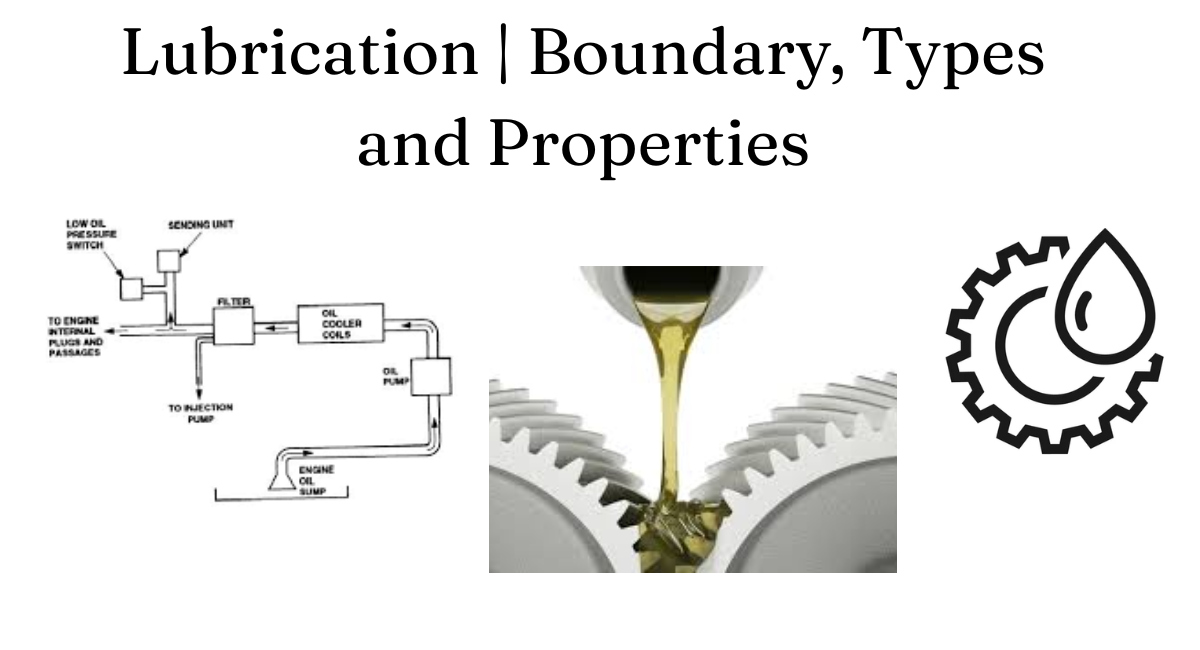
Lubrication is an essential concept in mechanical engineering and industrial machinery maintenance. It plays a major role in reducing friction, minimizing wear and improving the life of moving machine parts.
In mechanical systems such as bearings, gears, cams, engines and rotating shafts, lubrication helps maintain smooth motion and prevents direct contact between surfaces.
Lubricants are commonly used in industrial machines, automobiles, power plants, manufacturing equipment and heavy engineering applications.
Basic Principle of Lubrication
Lubrication is the admittance of oil between two surfaces having relative motion. The
objects of lubrication may be one or more of the following :
- To reduce friction between the parts having relative motion.
- To reduce wear of the moving part.
- To cool the surfaces by carrying away heat generated due to friction.
- To seal a space adjoining the surfaces.
- To absorb shocks between bearings and other parts and consequently reduce noise.
- To remove dirt and grit that might have crept between the rubbing parts.
Types of Lubrication
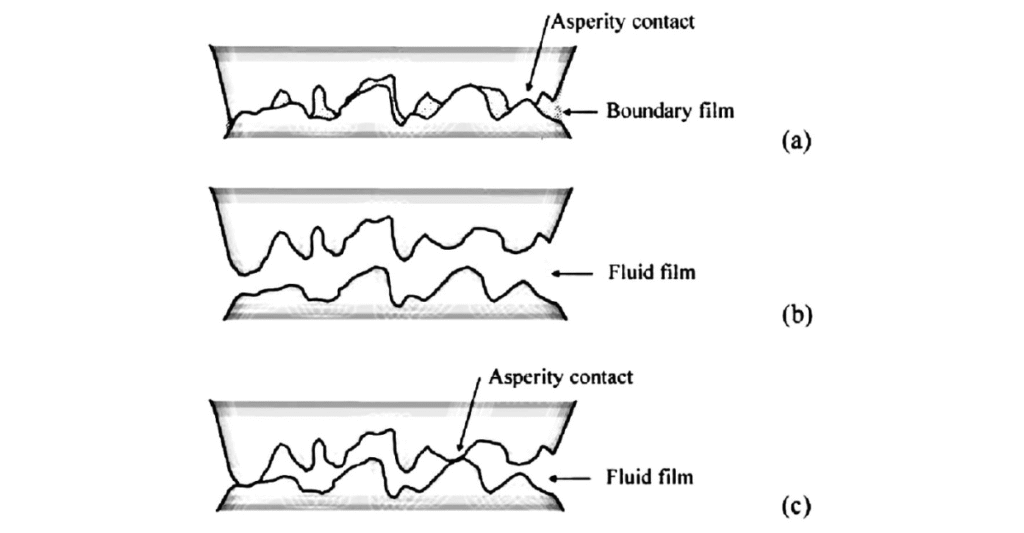
Boundary Lubrication
Under the hydro-dynamic condition the oil film supports the load. If the oil film becomes thin enough so as not to support the load without occasional metal to metal contact then journal friction developed is called boundary friction and the lubrication existing in this range is known as boundary lubrication.
Elasto-Hydrodynamic Lubrication
When the load acting on the bearings is very high, the material itself deforms elastically against the pressure built up of the oil film. This type of lubrication, called elasto-hydrodynamic lubrication, occurs between cams and followers, gear teeth and rolling bearings when the contact pressures are extremely high.
Quick Comparison: In boundary lubrication the oil film is too thin to fully separate the surfaces. In elasto-hydrodynamic lubrication the surfaces themselves deform elastically to help maintain the film under extreme pressure.
Types of Lubricants – Oils and Greases
Most lubricants are oils or greases. However, in special circumstances other fluids like water, air etc. and solids such as graphite may perform the function of lubrication. Synthetic lubricants are also used occasionally.
1. Oils
a) The different lubricating oils are : Mineral, Fatty and Synthetic. The mineral lubricating oils are obtained from the residual mass left during crude petroleum distillation. In this treatment gasoline, kerosene oil, and gas oil fractions are recovered from the distillate.
b) Fatty oils from animal and vegetable origin are sometimes used alone but are frequently mixed with mineral oils. The fatty oils exhibit poor keeping quality and undergo decomposition. Fatty oils however, exhibit more oiliness than mineral oils of the same viscosity.
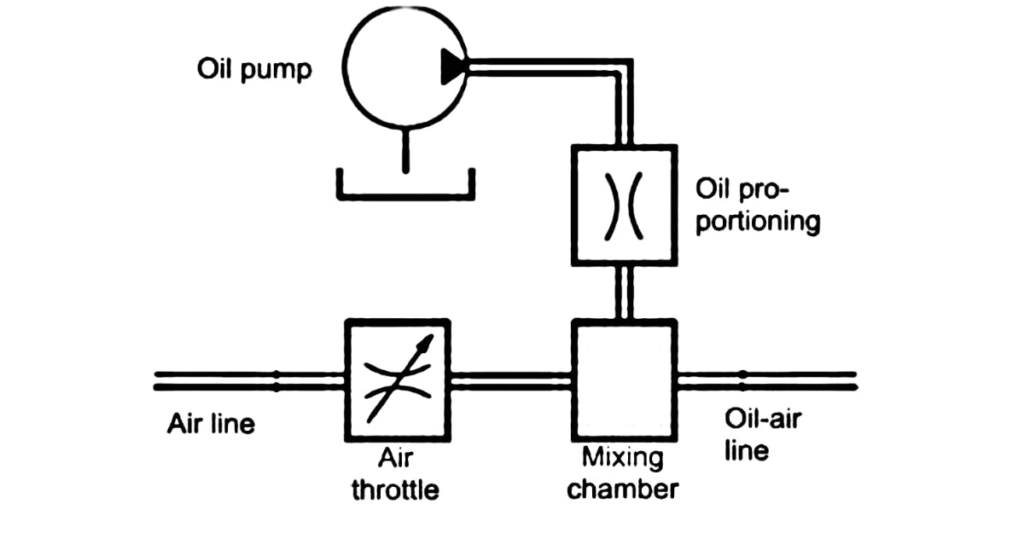
c) Synthetic lubricants are named synthetic because they are not obtained directly from petroleum.
d) Multigrade oils. It is possible to develop an oil with more than one viscosity at different temperatures. Thus an oil may be in SAE-30 grade at 99°C and in the SAE-10 W grade at – 18°C, oils of this type are known as multigrade oils ; other possible grades are : 5 W/20, 20 W/20, 20 W/40.
2. Greases
Lubricating grease is a solid to semi-solid dispersion of a thickening agent in liquid lubricant. Other ingredients imparting special properties may be included. Greases are normally used under conditions of lubrication for which oil is not as suitable or convenient.
A) Greases preform better than oils under conditions requiring :
- High bearing loads and shock loads.
- Slow journal speed.
- Temperature extremes.
- Cleanliness or avoidance of splash or drip.
- Minimum attention.
- A seal against external contaminants.
- Large bearing clearances.
B) The various types of greases used for lubrication are :
- Calcium soap greases
- Sodium soap greases
- Aluminium soap greases
- Mixed soap greases
- Barium soap greases
- Lithium soap greases
- Pure petroleum greases.
Properties of Lubrication
The chief qualities to be considered in selecting oil for lubrication are :
- Viscosity
- Corrosion
- Film strength
- Oiliness
- Emulsification
- Adhesiveness
- Specific gravity
1. Viscosity
It is the ability of the oil to resist internal deformation due to mechanical stresses and hence it is measure of the ability of the oil film to carry a load. A more viscous oil can carry a greater load, but it will offer greater friction to sliding movement of the one bearing surface over the other. Viscosity varies with the temperature and hence if a surface to be lubricated is normally at high temperature it should be supplied with oil of a higher viscosity. The viscosity is measured by viscosimeter. The unit of viscosity is given as “seconds saybolt” or “seconds redwood”.
2. Oiliness
This is the property which enables oil to spread over and adhere to the surface of the bearing. It is most important in boundary lubrication.
3. Corrosion
A lubricant should not corrode working parts. It must retain its properties even when foreign matter or additives are present.
4. Emulsification
When mixed with water, lubricating oil can emulsify and lose its property. The emulsification number indicates how much an oil tends to mix with water.
5. Adhesiveness
This is the property where oil particles stick to metal surfaces.
6. Film Strength
This allows the oil to retain a thin film between surfaces even at high speed and load, preventing direct metal contact. Adhesiveness and film strength help the lubricant enter metal pores and keep journals wet even when at rest.
7. Specific Gravity
A measure of the oil’s density, determined by a hydrometer. It helps in identifying the grade of the lubricant by comparing it with others.
Frequently Asked Questions (FAQs)
-
What is the basic principle of lubrication ?
Lubrication is the admittance of oil between two surfaces having relative motion. The primary principle is to reduce friction between parts, minimize wear and cool surfaces by carrying away heat generated during motion.
-
Define grease in lubrication?
Grease lubricant is a semi-solid to solid lubricant used to reduce friction and wear between moving parts. It consists of: Base Oil: Provides lubrication. Thickener: Gives grease its semi-solid consistency.
-
What is Boundary Lubrication?
Boundary lubrication occurs when the oil film becomes so thin that it can no longer support the load without occasional metal-to-metal contact. This creates boundary friction, often seen during high-load or low-speed operations.
Related Posts
- Electrical Machines Notes PDF (Handwritten) | Motors & DC Machines

- Lubrication: Principle, Types of Lubricants and Essential Properties
- Stepper Motors | Types, Parameters, and Characteristics
- Three Phase Induction Motor | Construction and Working Principle

- Static Phase Shifting Transformer | Configurations and Improvement

- Capacitive Voltage Transformer | Working, Characteristics, and Applications







Leave a Reply